
The First International Spring Academy on Media and Information Literacy Diplomacy (ISA‑MILID) marks an important moment for global dialogue on digital rights, cultural diversity, and human‑centred technological development.
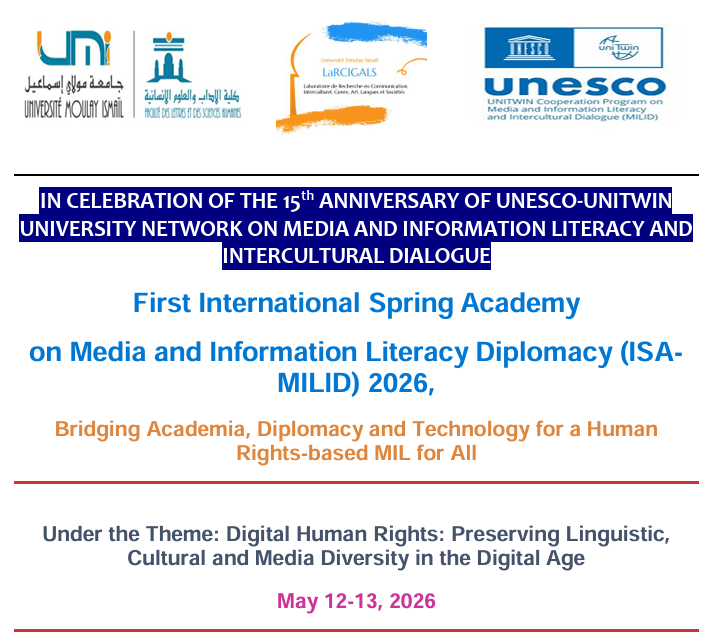
As the world celebrates the 15th anniversary of the UNESCO‑UNITWIN MILID Network, this gathering brings together scholars, diplomats, educators, and young researchers at a time when new forms of cooperation and new forms of digital responsibility are urgently needed.
The global context is challenging. Linguistic rights, cultural rights, media and information rights, and digital rights are facing unprecedented regression. Disinformation spreads faster than truth. Cultures and languages risk being homogenised. AI systems increasingly shape public discourse without always respecting human dignity. Many communities remain excluded from the digital world that now defines access to knowledge, opportunity, and participation. The ISA‑MILID Concept Note describes this moment as an era of shrinking freedoms and global erosion of trust — a moment that demands new thinking and new forms of action.
In this environment, Media and Information Literacy becomes more than a technical skill. It becomes a form of diplomacy — a way to defend human rights, strengthen democratic life, and build bridges across cultures. UNESCO calls this MIL Diplomacy, and it is within this framework that my contribution is positioned.
My speech introduces a pathway from dialogue to digital inclusion, a pathway toward peaceful, resilient, and human‑centred societies. This pathway is built on five essential pillars that together form the architecture of the Media Education Centre’s FUTURE Movement, a global framework for redefining development in the 21st century. These pillars reflect the belief that peace, development, digital inclusion, and human dignity are inseparable.
The first pillar, Media and Information Literacy, empowers individuals to access, analyze, and create information responsibly. It strengthens democratic participation, protects cultural and linguistic diversity, and reduces vulnerability to manipulation. In a world shaped by algorithmic information flows, MIL becomes a foundation for civic protection and intercultural understanding.
The second pillar, Digital Inclusion and Digital Wellbeing, ensures that all people — regardless of age, background, or ability — can participate fully in digital society. Digital wellbeing protects mental health, dignity, and safety in online spaces. Without inclusion and wellbeing, digital transformation becomes a source of inequality rather than empowerment.
The third pillar, Ethical and Trustworthy AI, addresses the growing influence of artificial intelligence on information ecosystems, public discourse, and access to opportunity. Ethical AI requires fairness, transparency, accountability, and respect for human rights. UNESCO’s people‑centred approach to AI Ethics is essential for building trust in digital spaces and ensuring that technology serves humanity rather than undermining it.
The fourth pillar, Intercultural Dialogue and Education for Reconciliation, focuses on the human relationships that sustain peaceful societies. Intercultural dialogue builds empathy and trust across differences. Education for reconciliation helps societies heal from conflict, overcome stereotypes, and strengthen social cohesion. This pillar reflects the mission of the Research Group on Intercultural Communication, Dialogue and Conflict Resolution, and it is essential for peaceful coexistence in multicultural environments.
The fifth pillar, Democratic Resilience, Human Rights, and the Right to Development, provides the ethical backbone of inclusive digital societies. Democratic resilience ensures that institutions remain trustworthy and open. Human rights protect freedom of expression, academic freedom, and the safety of journalists — all transversal themes of ISA‑MILID. The Right to Development must evolve to include digital access, digital literacy, digital wellbeing, and ethical AI. Without this modernization, entire societies risk being left behind.
Together, these five pillars form a coherent model for human‑centred development in the digital age. They reflect the core message of the FUTURE Movement of the Media Education Centre: that peace and development are inseparable; that reconciliation is essential for peace; that education is essential for reconciliation; that digital inclusion is essential for modern education; and that the Right to Development must be updated to reflect digital realities.
The speech invites participants to see themselves not only as observers but as co‑creators of this vision. It calls on young researchers, scholars, and practitioners to contribute to a global dialogue on how to protect diversity, dignity, and human development in the digital age. It emphasizes that the future of peace depends on our ability to unite cultural understanding, critical digital skills, and inclusive technological ecosystems into one shared human project.
This concept sets the intellectual foundation for your full speech, your workshop, and your contribution to ISA‑MILID 2026 — positioning the Media Education Centre and the FUTURE Movement as active partners in shaping a more just, inclusive, and human‑centred digital future.